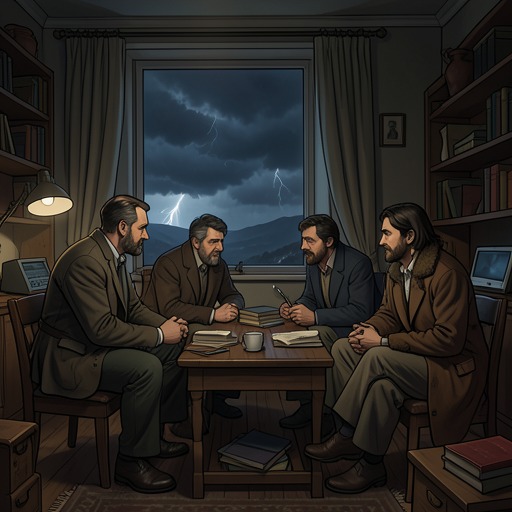
Pyotr Alexandrovitch Miusov
The Brothers KaramazovPyotr Alexandrovitch Miusov is a cultivated relative of the Karamazov family, a liberal freethinker and atheist whose visits and interventions bring him into the orbit of both the family’s quarrels and the town monastery. His defining tension is between the decorum he values and the indignation he cannot reliably contain: again and again, he tries to control a scene by acting as a gentleman, only to find his temper carrying him back into the conflict.
Identity and Background
Miusov is a cousin of Adelaida Ivanovna, the first wife of Fyodor Pavlovitch Karamazov, and thus connected to the family through its earliest marriage. When he returned from Paris as a young man, he took responsibility for Dmitri, who had been left in the care of others after his mother’s departure. His intervention mattered because Fyodor, preoccupied with his debaucheries, would otherwise have sent the child back to the cottage as an inconvenience. Miusov’s place in Dmitri’s childhood therefore begins not with intimacy but with a practical act of guardianship that keeps the boy from being abandoned again.
The narrative later encounters Miusov as a man who has spent many years abroad and who is again visiting his estate in the district. At this point he is described as a Liberal of the forties and fifties, a freethinker, and an atheist. These affiliations shape his response to the monastery: he approaches it neither as a believer seeking spiritual guidance nor as a neutral visitor, but as an educated man disposed to argue with its claims and institutions.
Return to the Karamazov Circle
Miusov’s presence becomes notable when Ivan is living with his father. The narrator emphasizes that Ivan and Fyodor are on unusually good terms, a circumstance that surprises those around them; Miusov is among the people who take notice. His connection to the family gives him a vantage point on its relationships, but the scenes do not make him an impartial judge. He is quick to form opinions, and his own liberal convictions ensure that the family’s religious and moral disputes become personal points of friction.
When Dmitri accepts a challenge concerning a visit to the monastery, Miusov eagerly joins the undertaking. Boredom or the prospect of a frivolous diversion may have helped prompt his enthusiasm. The decision is characteristic: he enters a charged situation partly as a spectator, expecting to see what will happen, yet his confidence in his own judgment and his ready indignation make simple observation impossible. The monastery visit draws him from social curiosity into direct confrontation with religious authority.
The Monastery Visit and Its Arguments
During the gathering, Miusov reacts sharply to the religious position voiced around him. He calls it “The purest Ultramontanism!” and crosses and recrosses his legs in impatience. His remark names the point of ideological collision: he hears an assertion of religious authority in terms that recall a political and ecclesiastical system he rejects. The response is not a considered treatise but a flash of irritation, consistent with the larger pattern in which Miusov’s cultivated identity meets a scene that frustrates his composure.
Miusov also takes the floor to tell an anecdote. He introduces it with a deliberately impressive air, presenting himself as someone able to bring an illustrative experience from Paris into the conversation. The detail matters to his social manner: he does not merely disagree but stages his contribution, drawing on his worldly experience and the authority of having moved in influential circles. The anecdote thus belongs both to the discussion and to Miusov’s performance of cultivated standing.
Before the gathering at the Father Superior’s, Miusov recognizes that he has lost his temper and feels ashamed. He resolves to repair the impression he has made through politeness, intending to show that he has been taken in by Fyodor’s behavior just as the others have. He also decides to end his litigation with the monastery and relinquish his claims to wood-cutting and fishery rights. Those rights have become much less valuable, which makes the concession easier; his reconciliation is therefore at once a social gesture and a practical decision shaped by the diminished worth of the dispute.
On arriving, he puts this resolution into action. He apologizes respectfully to the Father Superior for coming without Fyodor, addressing the religious leader in a dignified, affable tone. His manners are not simply a mask: he is genuinely troubled by his earlier loss of control and makes a deliberate effort to restore civility. Yet the scene’s dramatic force lies in the instability of that effort. The more Miusov attempts to master the encounter through polished conduct, the more visible the strain between his chosen manner and his actual feelings becomes.
Temper, Contradiction, and Narrative Role
Miusov’s self-command proves temporary. As the gathering proceeds, feelings that had subsided in his heart revive, and he declares that he cannot endure what is happening. Blood rushes to his head; he stammers, and his restraint gives way. This reversal follows his earlier apology and decision to relinquish the monastery claims, making his return to anger more than a passing outburst: it reveals how little civility can settle a conflict when the underlying convictions and resentments remain active.
Across these scenes, Miusov serves as a worldly counterpoint to the monks and a familial counterpoint to the Karamazovs. He brings political liberalism, atheism, property claims, and Parisian social experience into a religious setting, while his shifts between irritation and apology prevent him from standing outside the drama as a detached commentator. His presence also links separate periods of the family story: the young relative who takes charge of Dmitri’s guardianship reappears as an adult in the disputes surrounding Fyodor, Ivan, and the monastery. The connection is revealing but limited: the evidence establishes Miusov’s early practical role and later social entanglements, not a continuous account of his private life. What emerges is a figure whose cultivated self-image is repeatedly tested in public, and whose attempts at restraint give way whenever argument becomes too immediate to observe from a distance.